RTLinux-Based Radar Signal Acquisition and Processing System Design
Modern radar systems demand high-throughput data acquisition and deterministic real-time processing. As signal complexity and data volume increase, system performance is increasingly constrained by operating system latency, hardware bandwidth, and software architecture.
This article presents a redesigned radar signal acquisition and processing system based on RTLinux, focusing on real-time task control, system architecture, and performance validation.
🚧 Limitations of Legacy Radar Systems #
The original system exhibited several structural and performance bottlenecks:
- ISA bus architecture with limited throughput
- Slow signal acquisition and processing speed
- Multi-display output with poor visualization efficiency
- Frame loss under high-speed display conditions
- System instability under Windows 98
Real-Time Constraints #
Windows 98 lacks deterministic behavior:
- Unpredictable interrupt response latency
- Non-deterministic task scheduling
- Limited system customization
These limitations make it unsuitable for modern radar signal processing requirements.
⚙️ RTLinux Architecture and Advantages #
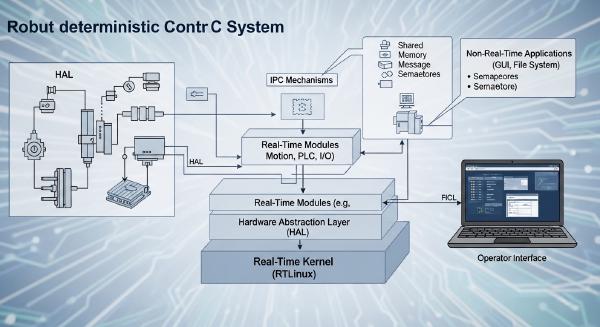
RTLinux enhances Linux with a lightweight real-time kernel, enabling deterministic task execution while retaining the full Linux ecosystem.
Core Characteristics #
- Hard real-time interrupt handling
- Kernel-space execution for real-time tasks
- User-space execution for non-real-time tasks
- Preemptive scheduling with strict priority control
RTLinux inserts a real-time layer between hardware interrupts and the Linux kernel, ensuring that time-critical tasks are always serviced first.
Performance Characteristics #
- Interrupt response time: microsecond-level latency
- Deterministic scheduling
- Scalable with hardware performance
These properties make RTLinux suitable for high-speed signal acquisition systems.
🖥️ System Architecture and Hardware Design #
The upgraded radar system integrates modern hardware components:
- High-performance PC platform
- PCI-based high-speed data acquisition board
- Signal transfer board
- Integrated display subsystem
Hardware Improvements #
- Migration from ISA to PCI bus (hundreds of MB/s throughput)
- High-speed A/D and D/A conversion
- On-board preprocessing and buffering
These upgrades significantly improve data acquisition bandwidth and processing efficiency.
🧩 Signal Acquisition and Processing Workflow #
The system processes radar signals in a multi-stage pipeline:
- Signal sampling via acquisition board
- Amplitude quantization and feature extraction
- Integration with azimuth and carrier frequency data
- Preprocessing to compute parameters:
- Carrier frequency
- Pulse width
- Pulse repetition interval
- Time of arrival
- Buffering and transfer to processing modules
- Analysis, visualization, and storage
This pipeline ensures continuous, high-throughput signal processing.
🔄 RTLinux Task Model and Control Framework #
The system divides tasks into real-time and non-real-time domains.
🧠 Real-Time Tasks (Kernel Space) #
- Data acquisition
- Signal control
- Hardware interaction
Functional Structure #
Each real-time module includes:
init_module()— resource allocation and task initializationcleanup_module()— resource release and task termination- Real-time task function — core processing loop
Responsibilities #
- Interrupt handling
- Data acquisition from hardware
- Immediate response to control signals
🖥️ Non-Real-Time Tasks (User Space) #
- Data analysis and decoding
- Signal visualization
- System control and configuration
Linux user space provides:
- Strong computation capabilities
- Graphical display support
- File and database integration
🔗 Inter-Process Communication Design #
Communication between system components is implemented using FIFO and shared memory mechanisms.
FIFO Channels #
- FIFO1: data transfer from real-time to user space
- FIFO2: internal control buffering
- FIFO3: control commands from user space to real-time modules
Communication Flow #
- Acquisition board triggers interrupt
- Real-time module reads data
- Data is transmitted via FIFO1
- User-space process performs analysis and visualization
- Control commands sent back via FIFO3
This design ensures deterministic data flow and low-latency control.
📊 Integrated Display System #
The upgraded system replaces multi-display output with a unified visualization interface.
Display Features #
-
Simultaneous visualization of:
- Azimuth
- Carrier frequency
- Pulse repetition frequency
- Pulse width
-
Improved clarity and persistence
-
Faster operator interpretation
This significantly enhances usability and operational efficiency.
🧪 Real-Time Performance Evaluation #
System performance was validated using interrupt response time measurements.
Test Environment #
- CPU: Pentium 4 (1.7 GHz)
- Memory: 256 MB
- Storage: 40 GB HDD
- Interrupt source: parallel port (10 μs interval)
Results #
- Single-task mode: 4–7 μs latency
- Multi-task mode: 7–9 μs latency
Analysis #
- Stable microsecond-level response
- Minimal degradation under multi-task load
- Meets real-time requirements for radar processing
🔍 Conclusion #
The RTLinux-based redesign significantly improves the performance and reliability of the radar signal acquisition and processing system.
Key outcomes:
- Deterministic real-time control with microsecond latency
- Increased data throughput via PCI-based acquisition
- Modular architecture with clear task separation
- Improved visualization and operator efficiency
- Enhanced system stability compared to legacy platforms
RTLinux provides a practical and scalable solution for modern radar systems, combining real-time determinism with the flexibility of Linux. This approach enables efficient upgrades of legacy systems while meeting the growing demands of high-speed signal processing.