RTLinux-Based Open Architecture CNC System Design and Implementation
Open-architecture CNC systems have become a central direction in modern manufacturing, driven by the need for flexibility, scalability, and integration with general-purpose computing platforms. This article examines the design and implementation of a CNC system built on RTLinux, focusing on real-time control, modular software architecture, and inter-process communication mechanisms.
🧭 Evolution of Open CNC Systems #
Since the 1990s, CNC development has shifted toward open architectures, enabling interoperability and extensibility. Initiatives such as NGC, OMAC, and OSACA reflect industry-wide efforts to standardize CNC platforms.
Industrial PCs (IPCs) provide a practical foundation for open CNC systems due to:
- Mature hardware ecosystems
- Rich software resources
- Strong networking capabilities
However, traditional operating systems present limitations:
Limitations of Conventional Systems #
- DOS: Strong real-time behavior but limited resources and single-tasking
- Windows: Rich UI and multitasking but lacks deterministic real-time control
These constraints highlight the need for a real-time operating system capable of supporting both deterministic control and complex application logic.
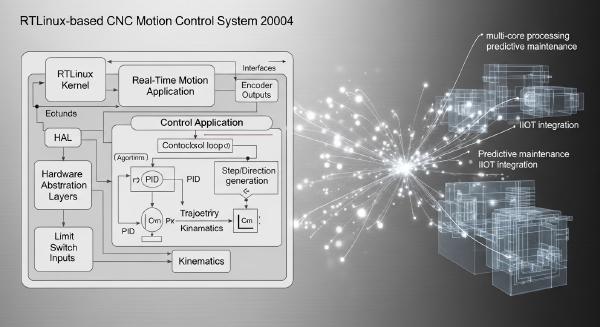
⚙️ RTLinux Architecture and Real-Time Model #
RTLinux extends the Linux kernel to provide hard real-time capabilities while preserving general-purpose functionality.
Core Design Principles #
- Real-time tasks execute in kernel space
- Non-real-time tasks execute in user space
- Linux kernel operates as a lower-priority task under RTLinux
Interrupt Handling Mechanism #
RTLinux introduces a virtual interrupt layer:
- Real-time interrupts are handled immediately by RTLinux
- Non-real-time interrupts are deferred to the Linux kernel via soft interrupts
This separation ensures deterministic response for time-critical operations while maintaining compatibility with standard Linux services.
🖥️ Hardware Architecture #
The system is built on a standard industrial PC platform with modular expansion:
- Standard bus interfaces for peripheral integration
- Configurable control cards and servo drive units
- Scalability across different performance requirements
This hardware abstraction aligns with open-architecture design principles.
🧩 Software Architecture #
The system software is divided into two domains based on timing requirements.
🔄 Real-Time and Non-Real-Time Partitioning #
Real-Time Modules #
- Interpolation
- I/O control
- Status monitoring
These modules require strict timing guarantees and run within RTLinux kernel space.
Non-Real-Time Modules #
- Human-machine interface (HMI)
- Parameter configuration
- File management
These run in user space and are scheduled by a master control module.
Modular Design Benefits #
- Low coupling between functional modules
- Independent module replacement and extension
- Compliance with open CNC system standards
🔗 Inter-Process Communication Mechanisms #
Efficient communication between modules is critical for system integrity.
Communication Within Non-Real-Time Domain #
- Shared buffers for large data (e.g., tool paths)
- Signals and messages for control flags
Communication Within Real-Time Domain #
- FIFO (First-In, First-Out) queues for deterministic data exchange
Cross-Domain Communication #
- FIFO: for ordered data streams (e.g., interpolation commands)
- Shared memory: for non-sequential data (e.g., status updates)
These mechanisms enable a layered and distributed control architecture.
🧪 FIFO and Shared Memory Implementation #
RTLinux provides standard interfaces for communication between kernel and user space.
FIFO Characteristics #
- Implemented as character devices
- Supports blocking read/write operations
- Unlimited instances (resource permitting)
Kernel-Space FIFO Operations #
nf_create(num, size)— create FIFOnf_get(num, buf, size)— read datanf_put(num, buf, size)— write datanf_destroy(num)— release FIFO
Shared Memory #
- Dedicated memory region for kernel-user communication
- Suitable for low-latency, non-sequential data exchange
💻 Real-Time Module Implementation Example #
The following illustrates a simplified RTLinux kernel module for CNC control:
void * Handle_CallBack(int fd) {
    while(1) {
        pthread_wait_up();
        get_fifo(1, buf1, size1);
        Send_TO_DA();
        Get_From_Counter();
        put_fifo(2, buf2, size2);
        IO_Handle();
    }
}

int init_module(void) {
    Start_IO();
    Start_DA();
    Start_Counter();
    Start_Servo();

    create_fifo(1, size1);
    create_fifo(2, size2);

    struct Sched_Param p;
    p.Sched_Priority = 1;
    pthread_setSchedParam(pthread_self(), SCHED_FIFO, &p);
    pthread_make_periodic_np(pthread_self(), gethrtime(), 80000);

    return pthread_create(&thread, NULL, Handle_CallBack, 0);
}

int cleanup_module(void) {
    End_DA();
    End_Counter();
    End_Servo();
    End_IO();

    destroy_fifo(1);
    destroy_fifo(2);

    destroy_delete_np(&thread);
}
Key Characteristics #
- Periodic real-time scheduling (8 ms cycle)
- Direct hardware interaction in kernel space
- Deterministic execution via FIFO-based communication
📊 System-Level Benefits #
The RTLinux-based CNC system achieves:
- Deterministic real-time performance
- Modular and extensible architecture
- Efficient resource utilization
- Compatibility with standard Linux tools
🔍 Conclusion #
RTLinux provides a practical and robust foundation for open-architecture CNC systems. By combining hard real-time capabilities with the flexibility of Linux, it enables precise control, scalable design, and efficient system integration.
This approach satisfies the core requirements of CNC control systems:
- Fast response
- High timing accuracy
- Predictable behavior
As industrial control systems continue to evolve, RTLinux-based architectures offer a compelling path toward fully open, high-performance CNC platforms.