RTLinux-Based FAST Feed Cabin Fine-Tuning Control System
🧭 Overview #
Precise positioning of the feed cabin in the Five-hundred-meter Aperture Spherical radio Telescope (FAST) is a hard real-time control problem requiring strict timing guarantees and sub-millimeter-level stability.
This system implements a real-time secondary fine-tuning control architecture on RTLinux, combining interrupt-driven execution, deterministic scheduling, FIFOs, and shared physical memory to maintain feed vibration within 4 mm using a Stewart platform.
📡 Control Requirements of the FAST Feed Cabin #
The FAST feed cabin is suspended at approximately 150 m height using a cable-driven support system. While effective for large-scale positioning, this mechanism alone cannot suppress high-frequency disturbances such as wind-induced motion.
To achieve fine positioning, a Stewart parallel mechanism is used:
- Upper platform: connected to feed cabin
- Lower platform: supports feed payload
- Six actuators: control 6-DOF motion
Core Real-Time Tasks #
Each control cycle must execute the following sequential operations:
- Cabin pose acquisition
- Trajectory prediction under dynamic disturbance
- Real-time target tracking
- Optimal trajectory planning
- Actuator command generation
All operations are strictly periodic and time-constrained. The system must maintain feed stability within 4 mm, even when cabin displacement reaches 50 cm.
⚙️ RTLinux as the Real-Time Control Platform #
The system requires deterministic scheduling with microsecond-level latency control. Several platforms were evaluated:
-
DOS
- Direct hardware access but no multitasking
- Severe memory and architectural limitations
-
Windows/NT
- Enhanced with VxD and threading models
- Still lacks deterministic real-time guarantees
-
RTLinux
- Hard real-time microkernel beneath Linux
- POSIX-compliant real-time API support
- Interrupt isolation from Linux kernel
- Typical interrupt latency < 15 µs
- Task jitter often < 35 µs (sub-µs on optimized x86 systems)
RTLinux was selected due to its hybrid architecture, deterministic behavior, and open-source flexibility.
🏗️ System Architecture #
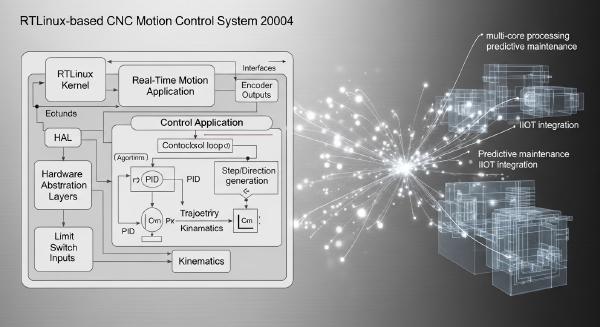
RTLinux separates execution into two domains:
-
Real-Time Domain
- Pose acquisition
- Prediction and trajectory computation
- Actuator control
- Exception handling
-
Linux (Non-Real-Time) Domain
- HMI interface
- Logging
- Network communication
This strict separation ensures that non-critical workloads cannot interfere with deterministic control execution.
⏱️ Timing Model and Control Synchronization #
The system is driven by a hardware interrupt clock from a servo motion control card:
- Base interrupt period: 2 ms
- Full control cycle: 100 ms (50 interrupts)
Control Strategy #
A synchronized timing strategy ensures actuator motion remains aligned with predicted cabin dynamics:
- Measurement and prediction share a 100 ms cycle
- Actuation is subdivided into 2 ms steps
- A calibrated 2 ms offset compensates computation delay
This ensures linearized actuator response across each cycle.
Execution Flow #
- Hardware interrupt triggers ISR
- ISR checks control flag state
- If enabled:
- Launch measurement/prediction thread
- Thread computes trajectory then suspends
- Next interrupts generate actuator outputs every 2 ms
- Cycle repeats every 100 ms
This design guarantees deterministic execution with bounded jitter.
🔄 Inter-Domain Communication #
Communication between real-time and non-real-time subsystems is implemented using two mechanisms:
FIFO Channels #
- POSIX-compliant unidirectional streams
- Used for:
- Command output
- HMI data transfer
- Throughput: up to ~100 MB/s
Shared Physical Memory #
- Bidirectional low-latency communication
- Used for:
- Pose targets
- System status flags
- Control synchronization variables
This hybrid design avoids unnecessary copying while preserving real-time determinism.
⚡ Interrupt-Driven Control Implementation #
The core scheduling mechanism is implemented entirely in the RTLinux ISR layer.
ISR Behavior #
// ISR (hardware interrupt handler)
pthread_create(...);   // spawn measurement & prediction thread
Real-Time Thread Behavior #
// Real-time control thread
pthread_suspend_np(pthread_self());
Execution Semantics #
- ISR triggers every 2 ms
- Measurement/prediction executes within a bounded time window (< 2 ms)
- Thread suspends after computation
- Next interrupt resumes actuator output phase
- Entire pipeline repeats every 100 ms
This guarantees:
- No missed deadlines
- No cumulative drift
- Deterministic scheduling under load
📊 System Performance Characteristics #
Validated on a 1:5 scale experimental platform, the system demonstrates:
- Sub-4 mm feed vibration control accuracy
- Stable tracking under wind-induced disturbances
- Deterministic execution with bounded jitter
- Reliable real-time scheduling under continuous load
Key outcomes:
- Strict timing guarantees maintained via hardware interrupt clock
- Predictable actuator synchronization with cabin motion
- Robust separation of control and non-real-time subsystems
✅ Conclusion #
The RTLinux-based FAST feed cabin fine-tuning system demonstrates that hard real-time control of large-scale astronomical structures can be achieved using:
- Hardware-interrupt-driven scheduling
- Interrupt-driven real-time threads
- FIFO-based communication channels
- Shared physical memory for synchronization
This architecture delivers deterministic performance and sub-millimeter-level stability, meeting the stringent requirements of the FAST telescope feed positioning system.