QNX Microkernel Explained with Code: How Neutrino Works
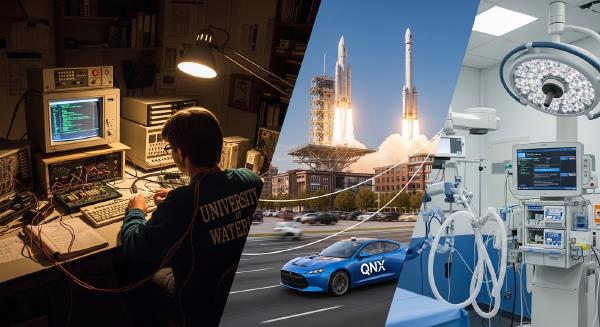
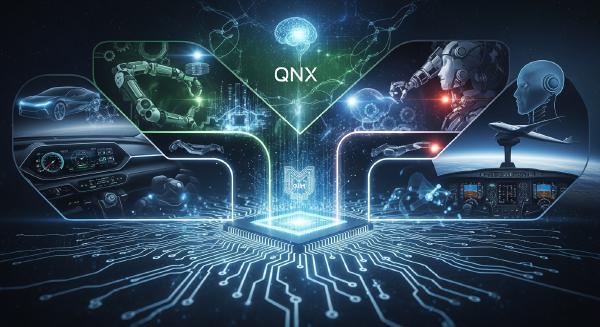
Understanding the QNX Neutrino microkernel is essential for engineers entering high-stakes domains like autonomous driving and medical robotics in 2026.
Unlike Linux or Windows, QNX is built as a collection of isolated, message-driven processes. The best way to understand it isn’t just theory—it’s seeing how code actually works.
⚙️ The Core: procnto
#
At the heart of QNX is procnto, which combines:
- A minimal microkernel (scheduling, timers, signals)
- A process manager (memory + process lifecycle)
This minimalism is what enables predictability and fault isolation.
🔗 IPC: Message Passing in Practice #
In QNX, everything communicates via messages. Let’s look at a minimal client-server example.
🧩 Server (Resource Manager Style – Simplified) #
#include <sys/neutrino.h>
#include <sys/dispatch.h>
#include <stdio.h>

int main() {
    int chid = ChannelCreate(0);
    printf("Server started, chid=%d\n", chid);

    struct {
        int value;
    } msg;

    int rcvid;

    while (1) {
        rcvid = MsgReceive(chid, &msg, sizeof(msg), NULL);
        if (rcvid == -1) continue;

        printf("Received: %d\n", msg.value);

        msg.value *= 2;  // simple processing

        MsgReply(rcvid, 0, &msg, sizeof(msg));
    }
}
🧩 Client #
#include <sys/neutrino.h>
#include <stdio.h>

int main() {
    int coid = ConnectAttach(0, 0, 1, 0, 0); // assume server chid=1

    struct {
        int value;
    } msg;

    msg.value = 21;

    MsgSend(coid, &msg, sizeof(msg), &msg, sizeof(msg));

    printf("Reply: %d\n", msg.value);  // Expect 42

    return 0;
}
🔍 What This Demonstrates #
- Synchronous communication (client blocks on
MsgSend) - No shared memory needed
- Clear ownership and flow control
This is fundamentally different from Linux-style system calls—everything is explicit and deterministic.
🛡️ Fault Isolation: Kill the Server, Not the System #
Because the server is just a process, you can kill it:
slay server_binaryWhat happens?
- The client receives an error
- The OS does not crash
- You can restart the server instantly
This is fault containment in action.
⏱️ Priority Inheritance in Action #
Let’s simulate a real-time scenario:
// High-priority thread sends message
MsgSend(coid, &critical_msg, sizeof(critical_msg), &reply, sizeof(reply));
If the server handling this is low priority, QNX will:
- Temporarily boost the server’s priority
- Ensure the request is handled immediately
- Restore priority afterward
No manual tuning required—this is built into the kernel scheduler.
🔄 Pulses: Lightweight Notifications #
For ultra-fast signaling, QNX provides pulses (no payload copying overhead):
MsgSendPulse(coid, SIGEV_PULSE_PRIO_INHERIT, 1, 0);Use cases:
- Interrupt notifications
- Event triggers
- Watchdog signals
Pulses are faster than full messages and ideal for high-frequency systems.
🚀 Development in 2026 #
QNX development is more accessible than ever:
- Non-commercial licenses available
- Cloud-based simulation environments
- Growing ecosystem around real-time AI and SDVs
🧠 Key Takeaways #
- QNX is message-first, not syscall-first
- Every component is replaceable and restartable
- Determinism is built into the architecture—not added later
📌 Final Thought #
If Linux teaches you how to build software, QNX teaches you how to build systems that cannot fail.
And in 2026, that skill is more valuable than ever.