QNX in 2026: The Invisible OS Powering Autonomous Systems
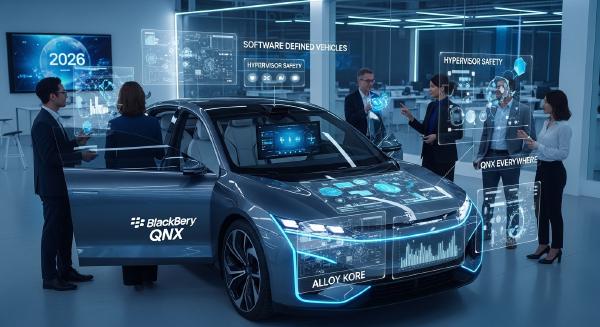
As of April 2026, the story of QNX has evolved far beyond its origins as a niche Unix-like system. Now developed by BlackBerry, it has become the invisible backbone of mission-critical computing, powering everything from autonomous vehicles to aerospace systems.
While consumers still associate BlackBerry with smartphones, the industry sees QNX as the gold standard for deterministic, real-time intelligence.
⚙️ The Microkernel Revolution (1980–2010) #
Founded in 1980 as Quantum Software Systems, QNX distinguished itself by doubling down on one core idea: the microkernel architecture.
-
Microkernel vs. Monolithic Design
Traditional systems like Linux and Windows use monolithic kernels, where drivers and core services run in kernel space.
QNX takes a radically different approach—running most components (drivers, file systems, networking) as isolated user-space processes. -
Fault Isolation and Recovery
This design enables true fault containment.
If a driver crashes, the system doesn’t fail—instead, the affected component is simply restarted. -
Self-Healing Systems
In safety-critical environments—like automotive braking or medical devices—this ability to recover instantly without system-wide failure is invaluable.
This architectural decision laid the foundation for QNX’s long-term dominance in reliability-focused industries.
🤖 From “BigDog” to Falcon: Extreme Reliability in Action #
QNX’s deterministic performance made it the OS of choice in environments where failure is not an option.
-
Robotics (Boston Dynamics)
In advanced robots like BigDog and Atlas, QNX manages high-frequency control loops.
Maintaining balance on unstable terrain requires control signals running at 1KHz (1,000 Hz) with near-zero latency jitter—something general-purpose OSes struggle to achieve. -
Aerospace (SpaceX Falcon Rockets)
QNX has been used in flight control systems where timing precision and reliability are critical.
In such environments, software errors can translate directly into mission failure.
These deployments highlight a key truth: real-time determinism beats raw compute power in critical systems.
🚀 The Modern Era: QNX SDP 8.0 (2024–2026) #
With the release of QNX Software Development Platform (SDP) 8.0, the platform has evolved to meet the demands of modern high-performance and AI-driven systems.
Why SDP 8.0 Matters #
-
Scalable Microkernel Architecture
Earlier RTOS designs struggled with many-core scaling.
SDP 8.0 introduces a redesigned scheduler and kernel architecture that efficiently utilizes 16+ core processors. -
Optimized for Modern SoCs
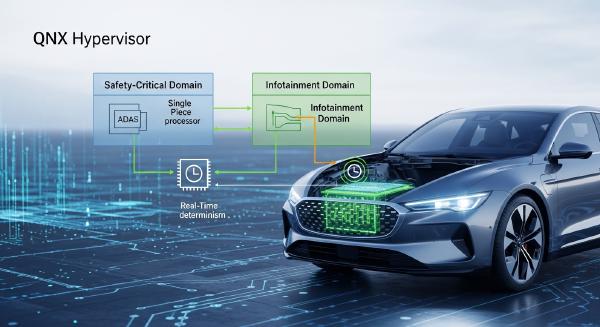
Platforms like NVIDIA Orin and Qualcomm Snapdragon Ride require both high throughput and strict timing guarantees—QNX now delivers both. -
Massive Automotive Adoption
By late 2024, QNX was deployed in over 235 million vehicles.
By 2026, that number is approaching 300 million, spanning:- Digital cockpits
- ADAS systems
- Autonomous driving stacks
-
Cloud-Native Development
With BlackBerry IVY and expanded cloud tooling, developers can simulate full QNX environments in AWS—dramatically accelerating development cycles.
QNX is no longer just “reliable”—it’s now scalable, connected, and cloud-integrated.
🔓 Opening Up: QNX’s Strategic Shift in 2026 #
To counter the rise of Automotive Grade Linux and other open ecosystems, BlackBerry is making a notable shift.
-
Non-Commercial Licensing
Students, researchers, and hobbyists can now access QNX more easily, lowering the barrier to entry. -
Selective Open Sourcing
Certain libraries and components are being opened to encourage ecosystem growth. -
Hybrid Ecosystem Strategy
QNX positions itself as a secure, real-time foundation, capable of running alongside open-source frameworks like ROS 2.
This move is less about abandoning control—and more about ensuring long-term relevance in a developer-driven world.
📊 Evolution of QNX #
| Era | Focus | Primary Industry |
|---|---|---|
| 1980s–90s | Microkernel Stability | Industrial Control / Medical |
| 2000s–10s | Embedded Reliability | Infotainment / Gaming / Aerospace |
| 2010s–20s | Safety & Security | ADAS / Cockpits / Robotics |
| 2024–2026+ | High-Performance Scaling | Autonomous Driving / AI Systems |
🧠 Final Take: The Hidden Giant #
QNX doesn’t dominate headlines—but it quietly powers systems where failure is unacceptable.
In 2026, its role is clearer than ever:
- Not a consumer OS
- Not an experimental platform
- But a foundation for mission-critical intelligence
As AI systems move from cloud to edge—and into cars, robots, and medical devices—the need for deterministic, fault-tolerant operating systems will only grow.
And QNX is already there.