Mastering VxWorks Programming: Real-Time Systems Guide 2026
🚀 Introduction: Why VxWorks Still Leads Real-Time Systems #
In the world of embedded systems, few platforms have maintained long-term dominance like VxWorks. Designed for deterministic, mission-critical applications, it powers everything from aerospace systems to industrial automation and intelligent edge devices.
What sets VxWorks apart is its ability to combine:
- Hard real-time determinism
- High reliability and safety certification
- Modern development capabilities (containers, AI/ML, multi-language support)
As of 2026, VxWorks continues to evolve, bridging traditional RTOS design with cloud-native and edge computing paradigms.
🧭 Evolution of VxWorks #
Originally introduced in 1987, VxWorks has undergone several major architectural transformations:
- VxWorks 5.x — Introduced robust networking (TCP/IP stack)
- VxWorks 6.x — Added SMP and memory protection
- VxWorks 7 — Fully modular architecture with decoupled components
Modern VxWorks supports:
- 32-bit and 64-bit architectures (x86, ARM, Power, RISC-V)
- Modular builds via VSB (VxWorks Source Build)
- Integration with modern toolchains and DevOps workflows
This evolution reflects a shift from tightly coupled embedded systems toward scalable, software-defined platforms.
🏗️ Core Architecture and Design Principles #
VxWorks uses a monolithic kernel optimized for performance, with optional modularization for safety and isolation.
Key Architectural Features #
-
Preemptive Priority Scheduling
Ensures highest-priority tasks execute with minimal latency -
Multi-Core Execution Models
- SMP (Symmetric Multi-Processing)
- AMP (Asymmetric Multi-Processing)
- BMP (Bound Multi-Processing)
-
Memory Protection Model
- RTPs (user mode, isolated)
- DKMs (kernel mode, high performance)
-
Integrated Networking Stack
Full BSD socket compatibility with IPv4/IPv6 and industrial protocols -
Security Framework
Secure boot, signed modules, and runtime protection aligned with modern threat models
This architecture enables both performance-critical and safety-critical workloads to coexist.
⚙️ Development Environment and Workflow #
Tooling Options #
- Wind River Workbench (Eclipse-based IDE)
- VS Code + SDK integration (lightweight workflows)
- Cross-compilers: GCC, Diab, Intel
Typical Development Flow #
- Configure BSP and build system image (VSB)
- Develop application (RTP or DKM)
- Cross-compile using toolchain
- Deploy via Ethernet, JTAG, or serial
- Debug using system tools or simulation (e.g., Simics)
Example: RTP Hello World #
#include <stdio.h>
#include <unistd.h>

int main(void) {
    printf("Hello from VxWorks RTP!\n");
    sleep(1);
    return 0;
}
Launch on target:
rtpSpawn("/ram0/hello.vxe", 0, 100, 0, 0);RTPs are preferred for safety and modularity due to memory isolation.
🧵 Multitasking and Scheduling #
Native Task Model #
VxWorks uses lightweight tasks instead of heavy processes.
#include <vxWorks.h>
#include <taskLib.h>

void myTask(int arg) {
    printf("Task running: %d\n", arg);
}

int main() {
    taskSpawn("tMyTask", 100, 0, 4096, (FUNCPTR)myTask, 42,0,0,0,0,0,0,0,0,0);
    return 0;
}
Key Characteristics #
- Priority range: 0 (highest) to 255 (lowest)
- Fully preemptive scheduling
- Optional round-robin for equal priorities
For portability, POSIX threads (pthread) are also supported.
🔄 Inter-Task Communication (IPC) #
Efficient IPC is essential in real-time systems.
Common Mechanisms #
- Semaphores (binary, counting, mutex with priority inheritance)
- Message Queues
- Pipes and Shared Memory
Example: Message Queue #
#include <vxWorks.h>
#include <msgQLib.h>

MSG_Q_ID msgQId;

void senderTask() {
    msgQSend(msgQId, "Hello VxWorks!", 14, WAIT_FOREVER, MSG_PRI_NORMAL);
}

void receiverTask() {
    char buf[32];
    msgQReceive(msgQId, buf, sizeof(buf), WAIT_FOREVER);
    printf("Received: %s\n", buf);
}
These primitives ensure deterministic and synchronized communication.
💾 I/O Systems and File Handling #
VxWorks supports multiple file systems:
- DOSFS (FAT-compatible)
- HRFS (high-reliability file system)
- NFS and raw block devices
Example: File Write #
#include <fcntl.h>
#include <unistd.h>

int fd = open("/usb0/log.txt", O_CREAT | O_WRONLY, 0666);
write(fd, "Log Entry\n", 10);
close(fd);
Drivers are implemented using the VxBus framework, enabling modular hardware abstraction.
🌐 Networking and Connectivity #
VxWorks includes a full BSD-compatible networking stack.
Capabilities #
- TCP/IP (IPv4/IPv6)
- Industrial protocols (OPC UA, TSN, CAN)
- Socket-based communication
Developers can reuse standard socket programming patterns with minimal changes.
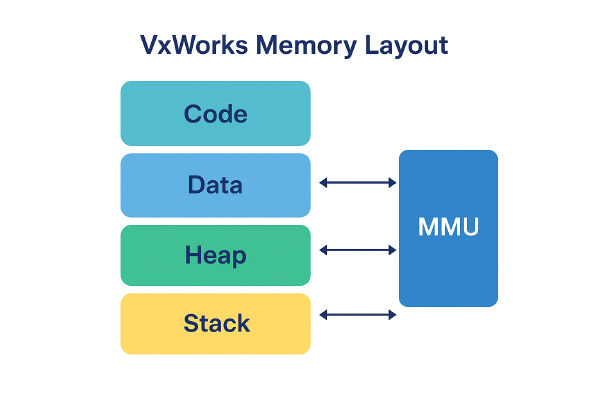
🧠 Memory Management #
Memory Domains #
- User Space (RTP) —
malloc/free - Kernel Space —
memPartAlloc
Advanced Features #
- MMU-based isolation
- Stack overflow protection
- Guard pages
These features are critical for fault containment and safety certification.
🚀 Modern Features in VxWorks 7+ #
Containerization #
- OCI-compatible containers
- Kubernetes orchestration support
- Cloud-native deployment at the edge
Multi-Language Support #
- C / C++17 (native)
- Rust (safe systems programming)
- Python (rapid prototyping, analytics)
AI and Edge Computing #
- TensorFlow Lite
- OpenCV
- ROS 2 integration
Virtualization #
- Runs as guest in hypervisors
- Supports simulation environments for testing
These features position VxWorks as a next-generation edge platform, not just a traditional RTOS.
⚠️ Best Practices for Robust Development #
- Use RTPs for safety-critical isolation
- Prefer POSIX APIs for portability
- Avoid busy-wait loops—use event-driven design
- Enable MMU and stack protection
- Profile using system tracing tools
- Validate in simulation before hardware deployment
- Follow certification workflows for safety-critical systems
🌍 Real-World Applications #
VxWorks is deployed in:
- Aerospace systems (flight control, space missions)
- Industrial robotics and automation
- Medical imaging systems
- Automotive ECUs and autonomous platforms
Its reliability and determinism make it a cornerstone of mission-critical computing.
🔭 Future Trends #
The future of VxWorks development is shaped by:
- Software-defined systems
- Edge AI integration
- Secure, containerized deployments
- Mixed-criticality system architectures
The RTOS is evolving into a hybrid platform combining real-time guarantees with cloud-native flexibility.
🧠 Key Takeaways #
- VxWorks remains a leading RTOS for deterministic, safety-critical systems
- Its architecture balances performance, modularity, and security
- Developers can leverage both native and POSIX APIs
- Modern features extend its capabilities into AI and cloud-native domains
- Mastering VxWorks enables development of scalable, future-ready embedded systems
VxWorks continues to set the benchmark for real-time embedded development—offering the tools, performance, and reliability required for the most demanding applications in 2026 and beyond.