RTLinux-Based Open Abrasive Waterjet CNC System Design
💧 Abstract #
Abrasive waterjet cutting is an advanced and environmentally friendly machining technology capable of processing a wide range of materials with high precision and no thermal deformation. However, many traditional waterjet CNC systems are still based on outdated DOS platforms or single-board computer architectures, resulting in poor openness, weak networking capability, and insufficient real-time performance.
This article presents the design and implementation of a new open abrasive waterjet CNC system based on the RTLinux real-time operating system. The platform adopts a modular architecture combining industrial PC hardware with dedicated motion control cards to achieve high-performance motion control and flexible system extensibility.
The software framework separates real-time and non-real-time functions into independent layers. RTLinux kernel modules handle time-critical interpolation and pulse control tasks, while Linux user-space applications provide graphical interfaces, diagnostics, and file management capabilities.
Experimental validation demonstrates that the system delivers excellent real-time responsiveness, high reliability, strong openness, and improved usability compared with traditional CNC controllers.
🏭 Introduction #
Abrasive waterjet cutting uses ultra-high-pressure water mixed with abrasive particles such as garnet to produce a high-velocity jet capable of cutting metals, composites, ceramics, glass, and many other materials.
Compared with conventional machining methods, abrasive waterjet cutting offers several significant advantages:
- No heat-affected zone
- Minimal material deformation
- Smooth cutting edges
- No burr formation
- No secondary processing requirement
- Dust-free and pollution-free operation
These characteristics make abrasive waterjet machining an important green manufacturing technology.
Despite these advantages, many existing waterjet CNC systems still rely on:
- DOS-based controllers
- Proprietary single-board computers
- Closed software architectures
Such systems typically suffer from:
- Limited functionality
- Poor user interfaces
- Weak networking support
- Difficult maintenance and expansion
- Inadequate real-time performance
To overcome these limitations, this design introduces an open CNC system based on RTLinux and a modular PC + motion control card architecture.
⚙️ Functional Requirements of Abrasive Waterjet CNC Systems #
Abrasive waterjet machines generally fall into two categories:
- Front-mixing systems
- Rear-mixing systems
In both cases, the core machining process depends on highly accurate planar motion control of the cutting nozzle assembly.
Core Functional Requirements #
The CNC system must support several critical capabilities.
Precision Trajectory Control #
The controller must execute:
- Linear interpolation
- Circular interpolation
- Continuous contour motion
with high positional accuracy and deterministic timing.
Real-Time Valve and Pump Control #
The system must control multiple machine subsystems in real time, including:
- Abrasive valves
- Water valves
- High-pressure pumps
- Nozzle actuators
Because waterjet cutting frequently switches valves during complex nesting operations, response latency must remain extremely low.
Dynamic Feedrate Regulation #
Cutting quality depends heavily on feedrate stability and adaptive speed control. The controller must dynamically adjust motion speed according to machining conditions.
Machine Monitoring and Diagnostics #
The platform must continuously monitor:
- Water pressure
- Electrical current
- Motion state
- Alarm conditions
while providing real-time diagnostic feedback to operators.
User-Friendly Interface #
Modern CNC systems require:
- Graphical trajectory simulation
- Real-time machining visualization
- Interactive parameter editing
- Alarm reporting
Traditional Windows NT-based systems often fail to satisfy these strict real-time requirements, particularly under heavy multitasking conditions.
🧩 System Architecture #
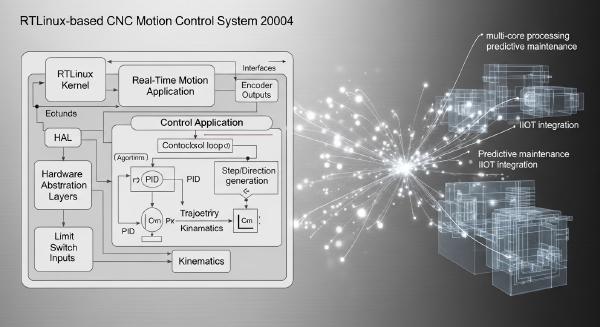
The proposed system adopts an open and modular software architecture built on RTLinux.
Layered Architecture Design #
The software stack is divided into two primary layers:
Real-Time Layer #
Running inside RTLinux kernel space, this layer handles:
- Interpolation computation
- Motion pulse generation
- Interrupt handling
- Real-time machine monitoring
Non-Real-Time Layer #
Running in standard Linux user space, this layer manages:
- Human-machine interface
- File editing
- G-code parsing
- Diagnostics
- Simulation and visualization
This separation allows the system to achieve hard real-time motion control while maintaining the flexibility and openness of Linux.
Advantages of the Open Architecture #
The modular architecture provides several benefits:
- Easy functional expansion
- Improved maintainability
- Hardware independence
- Better networking capability
- Support for distributed manufacturing systems
The use of standard PC hardware also significantly reduces development and maintenance costs.
⏱️ RTLinux Real-Time Control Mechanism #
RTLinux extends the standard Linux kernel with hard real-time capabilities through several core mechanisms.
Interrupt Emulation #
RTLinux intercepts hardware interrupts before the Linux kernel processes them.
The interrupt handling strategy works as follows:
- Real-time interrupts are serviced immediately
- Non-real-time interrupts are forwarded to Linux
This mechanism guarantees deterministic interrupt latency for motion control tasks.
High-Resolution Timer Management #
RTLinux supports both:
- One-shot timers
- Periodic timers
with high timing precision suitable for CNC interpolation cycles.
Priority-Based Scheduling #
Real-time tasks execute with absolute priority over standard Linux processes.
On x86 platforms, interrupt response latency is typically:
- Less than 15 microseconds
This deterministic scheduling model is critical for high-precision motion control systems.
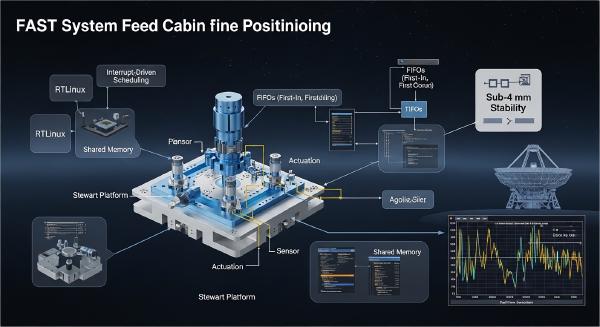
Real-Time FIFO Communication #
RTLinux provides rt_fifo communication channels for deterministic data exchange between:
- Kernel-space real-time tasks
- Linux user-space applications
These FIFOs enable efficient inter-process communication without compromising real-time behavior.
🧠 Real-Time Module Implementation #
The real-time module is the core component of the CNC control system.
Interpolation Task #
The interpolation thread, waterjet_interpolate_thread, performs trajectory computation.
Its responsibilities include:
- Reading decoded G-code from
fifo_decode - Executing linear and circular interpolation
- Writing pulse data to
fifo_interp
Task characteristics:
- Period: 1 ms
- Priority: Highest
The interpolation cycle directly determines motion smoothness and machining precision.
Function Control Task #
The waterjet_control_thread manages operational commands such as:
- Machine start/stop
- Feedrate override
- Abrasive valve switching
- Water valve control
Task configuration:
- Period: 4 ms
- Priority: Medium-high
This task ensures responsive machine operation while maintaining synchronization with motion control.
Monitoring Task #
The waterjet_monitor_thread performs continuous system monitoring.
Functions include:
- Coordinate acquisition
- Water pressure monitoring
- Current monitoring
- Safety checking
- Alarm handling
Task configuration:
- Period: 4 ms
- Priority: Medium
The monitoring subsystem improves operational safety and fault detection capability.
Pulse Output Interrupt Handler #
The pcl_irq_routine interrupt service routine handles motion pulse output.
Its primary responsibilities are:
- Reading interpolated pulse data
- Writing pulse commands to motion control card registers
- Maintaining deterministic pulse timing
Accurate pulse timing is essential for maintaining motion precision and contour accuracy.
🔄 Real-Time Data Flow #
The system uses RT-FIFO channels for communication between tasks and modules.
FIFO Communication Channels #
Key communication FIFOs include:
fifo_decodefifo_cmdfifo_interpfifo_monitor
These FIFOs provide deterministic and efficient data transfer between:
- G-code decoding modules
- Interpolation tasks
- Motion output handlers
- Monitoring subsystems
Deterministic Task Coordination #
The FIFO-based communication architecture improves:
- System stability
- Timing predictability
- Task decoupling
- Scalability
while minimizing synchronization overhead.
💻 Real-Time Thread Example #
The interpolation task uses RTLinux periodic scheduling APIs to guarantee deterministic execution timing.
Example Thread Framework #
void *waterjet_interpolate_routine(void *arg) {
    struct sched_param p;
    p.sched_priority = 1;

    pthread_setschedparam(pthread_self(), SCHED_FIFO, &p);

    pthread_make_periodic_np(
        pthread_self(),
        gethrtime(),
        1000000
    );  // 1 ms period

    while(1) {
        pthread_wait_np();

        // Read from fifo_decode
        // Perform interpolation
        // Write pulse data to fifo_interp
    }
}
This structure guarantees periodic execution with hard real-time scheduling behavior.
Module Lifecycle Management #
Kernel modules are dynamically managed using:
init_module()cleanup_module()
This mechanism improves modularity and simplifies system maintenance.
🖥️ Non-Real-Time Main Control Module #
The non-real-time subsystem runs in standard Linux user space and provides operator-facing functionality.
Main Functions #
The user-space module supports:
- G-code editing
- Graphical trajectory preview
- Real-time path tracking
- Alarm management
- Nozzle compensation
- Position display
- Machining cost estimation
These functions significantly improve usability compared with traditional DOS-based systems.
🎨 QT-Based Human-Machine Interface #
The human-machine interface is developed using the QT framework under the X Window environment.
Advantages of QT #
QT provides several advantages for CNC applications:
- Rich graphical widgets
- Cross-platform portability
- Real-time visualization capability
- Flexible UI customization
Graphical Machining Support #
The interface enables:
- Visual trajectory verification
- Path simulation
- Interactive editing
- Real-time machining feedback
Operators can visually compare programmed trajectories against target contours, reducing programming errors and improving machining reliability.
📈 System Advantages #
Compared with traditional waterjet CNC controllers, the RTLinux-based architecture provides substantial improvements.
Superior Real-Time Performance #
Key real-time advantages include:
- Deterministic scheduling
- Microsecond-level interrupt response
- Stable interpolation timing
- Reliable valve response
These capabilities are difficult to achieve using conventional Windows NT or DOS-based platforms.
High Openness and Extensibility #
The Linux-based architecture enables:
- Modular software development
- Easy feature expansion
- Third-party integration
- Remote networking capability
The open architecture also simplifies future upgrades and customization.
Enhanced User Experience #
The QT-based interface improves operator efficiency through:
- Graphical interaction
- Real-time diagnostics
- Machining simulation
- Intuitive parameter management
Networking and Remote Support #
The Linux ecosystem provides powerful support for:
- Remote diagnostics
- Networked manufacturing
- Distributed machine coordination
- Data sharing
These capabilities are essential for modern intelligent manufacturing systems.
🧪 Experimental Validation #
System testing demonstrated strong performance across several critical areas.
Real-Time Motion Control #
The RTLinux scheduling framework maintained:
- Stable interpolation timing
- Precise pulse generation
- Smooth contour machining
during continuous operation.
Reliability Testing #
The system demonstrated:
- Stable long-term operation
- Reliable interrupt handling
- Accurate valve switching
- Consistent monitoring performance
Usability Improvements #
Compared with older CNC systems, the new platform provided:
- Better graphical interaction
- Easier parameter configuration
- Faster fault diagnosis
- Improved maintainability
🚀 Future Development Directions #
The RTLinux-based open CNC platform provides a strong foundation for future expansion.
Potential future enhancements include:
- CAD/CAM integration
- Intelligent process optimization
- Remote monitoring systems
- Multi-machine coordination
- Industrial IoT connectivity
- Adaptive cutting algorithms
The open architecture makes these upgrades significantly easier to implement compared with closed legacy systems.
🏁 Conclusion #
This article presented the design and implementation of an open abrasive waterjet CNC system based on RTLinux.
By combining:
- Hard real-time Linux control
- Modular software architecture
- PC-based hardware platforms
- Motion control card integration
- QT graphical interfaces
the system successfully overcomes many limitations of traditional DOS-based and single-board CNC controllers.
The RTLinux architecture delivers:
- Excellent real-time performance
- High reliability
- Strong openness
- Improved maintainability
- Better user interaction
Experimental results confirm that the platform provides a practical and scalable solution for modern abrasive waterjet machining systems while establishing a solid technical foundation for future intelligent manufacturing applications.