QNX-Based Ethernet Fieldbus Multi-Computer Communication Design
High-performance industrial control systems require deterministic communication, scalability, and interoperability. In large-scale systems such as fusion device control, these requirements become even more stringent due to distributed architecture and high signal density.
This article presents the design and validation of a multi-computer communication system over an Ethernet fieldbus using QNX and Modbus TCP/IP, with a focus on real-time performance and communication reliability.
🌐 System Architecture Overview #
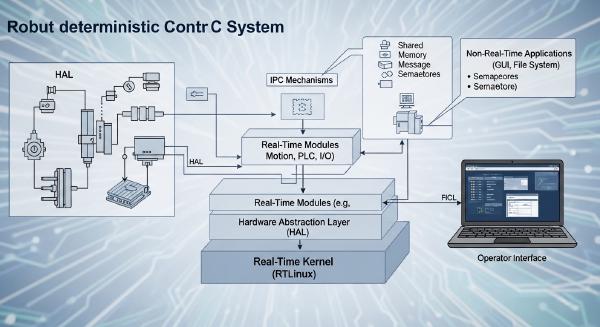
The control system is structured into three logical layers:
- Monitoring layer: Windows-based interface for visualization, diagnostics, and waveform analysis
- Real-time control layer: QNX-based deterministic control and scheduling
- Fieldbus layer: Ethernet-based distributed I/O and execution
This layered architecture separates concerns while enabling scalable and maintainable system design.
Functional Responsibilities #
- Monitoring layer: user interaction and data visualization
- QNX layer: feedback control, protection, and scheduling
- Fieldbus layer: device-level signal acquisition and actuation
🔌 Ethernet Fieldbus Design #
Ethernet fieldbus provides an open, scalable, and cost-effective alternative to traditional industrial buses.
Protocol Selection #
The system adopts Modbus TCP/IP, chosen for:
- Wide industry adoption
- Open standard interoperability
- Simplicity in controller communication
Modbus TCP/IP Frame Structure #
A typical frame includes:
- Transaction identifier
- Protocol identifier
- Message length
- Unit identifier
- Function code
- Data payload
Error checking is handled by TCP/IP and lower network layers, eliminating the need for additional CRC fields.
Industrial Ethernet Stack #
The system integrates multiple protocol layers:
- Network layer: IP, ARP, ICMP
- Transport layer: TCP or UDP
- Application layer: Modbus TCP/IP, HTTP
Fieldbus modules use:
- Port 502 for Modbus communication
- Port 80 for monitoring via embedded web interfaces
🏭 Fieldbus Layer Implementation #
The system employs Ethernet-based fieldbus controllers and distributed I/O modules.
Key Characteristics #
- Thousands of control and status signals
- Distributed across multiple subsystems
- Connected via standard 100 Mbps Ethernet
Hardware Selection #
- Ethernet fieldbus modules (e.g., WAGO series)
- Digital and analog I/O modules
- Standard network infrastructure (NICs, switches, cables)
Advantages #
- Reduced wiring complexity
- High scalability
- Cross-platform compatibility (Windows, UNIX, QNX)
⚙️ QNX-Based Communication Model #
QNX provides a microkernel real-time architecture with strong IPC and networking capabilities.
Communication Mode #
Two transport options are available:
- TCP: reliable, connection-oriented
- UDP: low-latency, connectionless
The system selects UDP due to:
- Small packet size
- High responsiveness requirements
- Reduced protocol overhead
Socket Programming Model #
Communication is implemented using BSD Socket APIs:
sock = socket(AF_INET, SOCK_DGRAM, 0);
server.sin_family = AF_INET;
server.sin_addr.s_addr = inet_addr(HOST_FIELD_CTL);
server.sin_port = htons(PORT_FIELD_CTL);
ioctl(sock, FIONBIO, &on);- Non-blocking mode ensures responsiveness
sendto()andrecvfrom()handle data exchange
🔄 Multi-Computer Communication Strategy #
In distributed systems, multiple control nodes must communicate with shared fieldbus devices.
Challenges #
- Increased network contention
- Packet collision and loss
- Timing coordination across nodes
Synchronization Approach #
- All upper computers operate on synchronized timers
- Each sends control data at aligned intervals
- Packet timing is adjusted to avoid overlap
🧪 Communication Cycle Optimization #
A key objective is determining the minimum communication cycle that ensures zero packet loss.
Single-Computer Results #
- ≥4 ms: 0% packet loss
- 3 ms: <0.1% loss
- 2 ms: ~29% loss
- 1 ms: >97% loss
Optimal cycle: 4 ms
Multi-Computer Results #
For two computers:
- ≥6 ms: 0% packet loss
- 5 ms: <0.5% loss
- 4 ms: ~24% loss
Optimal cycle: 6 ms
Generalized Observation #
- Reliable communication requires cycle ≥ n × 3 ms
- n = number of communicating nodes
This ensures sufficient spacing between packets to avoid congestion and loss.
📊 Performance Analysis #
Despite Ethernet’s high bandwidth (100 Mbps), protocol overhead introduces latency:
- Full TCP/IP stack complexity
- Processing overhead at both sender and receiver
- Increased contention in multi-node scenarios
Key Insight #
Raw bandwidth does not guarantee real-time performance. Deterministic timing must be engineered through controlled communication cycles.
🔍 Practical Implications #
The optimized communication model enables:
- Reliable real-time control
- Scalable multi-node architecture
- Deterministic system behavior
These characteristics are critical for large-scale industrial systems such as fusion power control.
🧾 Conclusion #
The QNX-based Ethernet fieldbus communication system demonstrates that reliable real-time performance can be achieved over standard networking technologies when properly engineered.
Key outcomes:
- Successful implementation of multi-computer communication using Socket API
- Identification of optimal communication cycles for zero packet loss
- Validation of UDP-based communication for low-latency control
- Scalable architecture suitable for complex distributed systems
This approach provides a practical foundation for deploying high-performance, real-time industrial control systems using open networking standards.