VxWorks RTOS: Architecture, Features and Real-Time Applications
VxWorks is a proprietary, high-performance real-time operating system (RTOS) developed by Wind River for systems where predictable execution, low latency, reliability, and long-term support are critical.
Unlike general-purpose operating systems optimized primarily for throughput and user-facing workloads, VxWorks is designed around deterministic real-time behavior. Its architecture provides developers with fine-grained control over task scheduling, interrupt handling, memory, interprocess communication, networking, and system resources.
The platform has consequently become a long-standing choice for safety-critical and mission-critical applications spanning aerospace, defense, industrial automation, telecommunications, medical systems, and scientific infrastructure.
⚙️ VxWorks Architecture and Real-Time Design #
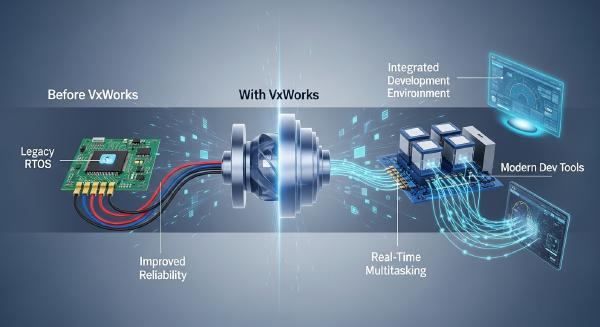
VxWorks is built around a modular architecture that allows developers to select the operating-system capabilities required by a particular embedded application.
The design emphasizes predictable scheduling and low execution latency while keeping unnecessary services out of constrained systems.
Deterministic preemptive scheduling #
The VxWorks kernel uses priority-based preemptive scheduling, allowing higher-priority tasks to interrupt lower-priority tasks when required.
This behavior is fundamental to real-time systems.
A conventional desktop operating system may tolerate variable scheduling latency as long as average throughput remains high. A flight-control computer, industrial controller, or communications system may instead require a particular operation to execute within a defined timing window.
VxWorks is therefore optimized around characteristics such as:
- Low interrupt latency
- Predictable task scheduling
- Priority-based execution
- Fast context switching
- Controlled resource contention
- Deterministic response behavior
These properties allow developers to design systems around explicit timing requirements rather than relying primarily on average-case performance.
Modular microkernel architecture #
VxWorks uses a modular kernel architecture that allows system functionality to be configured according to application requirements.
Developers can remove unnecessary services and components to reduce memory consumption and system complexity.
This is particularly useful for embedded hardware where memory, storage, processing capacity, and power budgets are significantly more constrained than on conventional computing platforms.
The modular approach also allows different products to use substantially different operating-system configurations while retaining the same underlying development environment.
🔄 Task Synchronization and Interprocess Communication #
Real-time applications typically consist of multiple concurrent tasks that must coordinate access to shared resources and exchange data predictably.
VxWorks provides several synchronization and interprocess communication mechanisms, including:
- Semaphores
- Mutexes
- Message queues
- Shared memory
- Task synchronization primitives
- Event mechanisms
These facilities allow developers to construct multi-tasking applications while controlling access to shared resources.
Memory management #
VxWorks supports both static and dynamic memory-management approaches.
Static allocation can provide stronger predictability for safety-critical applications because memory requirements are established before execution.
Dynamic allocation offers greater flexibility for applications where workloads or resource requirements vary during runtime.
The appropriate model depends on the application’s timing, certification, reliability, and resource constraints.
🧩 Hardware and Networking Support #
VxWorks supports a broad range of processor architectures used in embedded and industrial systems.
Depending on the product version and hardware platform, support includes architectures such as:
- ARM
- x86 and x64
- PowerPC
- MIPS
- RISC-V
This hardware flexibility allows VxWorks to span small embedded controllers, high-performance networking equipment, aerospace computers, and other specialized platforms.
Networking and peripheral stacks #
Modern embedded systems frequently require connectivity in addition to deterministic local control.
VxWorks provides networking and peripheral support covering technologies such as:
- TCP/IP and IPv6
- Ethernet
- USB
- Wi-Fi
- FAT
- NFS
- Network management protocols
This enables developers to combine real-time control functions with networking, storage, and device-management capabilities within the same embedded platform.
🛡️ Safety, Security and Certification #
One of VxWorks’ major differentiators is its use in applications where software failures can have significant operational or safety consequences.
The platform includes capabilities designed to support secure and isolated execution, including:
- Secure Boot
- Memory protection
- Cryptographic libraries
- Access-control mechanisms
- Process and task isolation
- Safety-oriented system configurations
For regulated industries, operating-system capabilities are only one part of the certification process. The complete hardware, software, development process, configuration, and application must satisfy the applicable standards.
Aerospace and industrial certification #
VxWorks has been used in systems subject to demanding aerospace and industrial requirements, including applications developed under standards such as DO-178C.
Certification-oriented development requires more than simply selecting a compliant RTOS. Developers must establish appropriate verification, traceability, configuration management, testing, and documentation throughout the software lifecycle.
VxWorks provides tooling and platform capabilities intended to support these workflows.
🚀 Aerospace and Defense Applications #
Aerospace and defense are among VxWorks’ most prominent application areas.
Real-time operating systems are particularly valuable in spacecraft, avionics, guidance systems, mission computers, and autonomous platforms because these systems must respond predictably to external events.
Reported and notable VxWorks deployments include NASA’s Spirit, Opportunity, and Curiosity Mars rovers, Boeing 787 avionics systems, and robotic systems associated with the International Space Station.
Why RTOS determinism matters in spacecraft #
Spacecraft software must coordinate sensors, actuators, communications, navigation, power management, and scientific instruments while operating with strict timing and resource constraints.
A deterministic RTOS can provide a controlled execution environment in which critical tasks receive predictable scheduling priority.
This is especially important when software must operate autonomously for extended periods without immediate intervention from operators.
🏭 Industrial Automation #
Industrial automation systems use RTOS platforms for applications where machine operations must occur within precise timing windows.
VxWorks is used across areas such as:
- Industrial robotics
- Programmable logic controllers
- Distributed control systems
- Machine-control platforms
- Factory automation
- Industrial networking
In these environments, timing errors can result in reduced productivity, equipment damage, or unsafe operating conditions.
Deterministic task scheduling allows control software to respond consistently to sensor input and execute actuator commands within defined timing constraints.
📡 Telecommunications and Networking #
VxWorks is also used extensively in communications infrastructure.
Network equipment requires predictable packet processing, hardware management, fault handling, and control-plane operations while supporting high-throughput data paths.
Typical applications include:
- Core routers
- Network switches
- 5G infrastructure
- Radio Network Controllers
- Satellite communications systems
- Network appliances
The combination of real-time execution and integrated networking support makes VxWorks suitable for embedded networking platforms where conventional desktop-oriented operating systems may introduce unnecessary complexity or latency.
🏥 Medical and Scientific Systems #
Medical technology represents another domain where deterministic embedded software can be valuable.
VxWorks has been used in systems such as patient-monitoring equipment, imaging platforms, and medical robotics.
Scientific infrastructure can have similarly demanding control requirements.
For example, real-time control software is used in large experimental facilities where thousands of sensors, actuators, and subsystems must operate in coordinated sequences.
VxWorks has also been associated with control systems used in scientific research infrastructure, including CERN-related systems.
🛠️ Development Toolchain and Engineering Workflow #
VxWorks is supported by Wind River’s commercial development ecosystem.
The Wind River Workbench environment provides integrated development and debugging capabilities for embedded software engineers.
Relevant tooling includes:
- Real-time debugging
- Performance profiling
- System tracing
- Static analysis
- Configuration management
- Application development
- Target-device diagnostics
These tools are particularly important for complex embedded systems because debugging timing-sensitive failures can be substantially more difficult than debugging conventional application software.
A failure may depend on task priority, interrupt timing, resource contention, or a specific sequence of hardware events.
💼 Commercial Model and Engineering Trade-Offs #
VxWorks is proprietary commercial software rather than an open-source RTOS.
Its commercial model provides access to vendor-supported software, engineering tools, maintenance, and long-term platform development.
Depending on the deployment and agreement, licensing can involve subscription, enterprise, or other commercial arrangements.
Advantages #
VxWorks is attractive when an organization prioritizes:
- Deterministic real-time behavior
- Long-term vendor support
- Safety-critical development
- Hardware and processor flexibility
- Mature networking capabilities
- Professional debugging and analysis tools
- Established aerospace and industrial deployment history
Trade-offs #
The main disadvantages are associated with its commercial and proprietary nature.
Compared with open-source alternatives, VxWorks can involve substantially higher licensing and support costs. Its closed-source architecture also provides less freedom to modify the operating system at the source level.
Organizations must therefore weigh vendor support and certification-oriented capabilities against licensing costs and reduced control over the underlying platform.
📊 VxWorks in the RTOS Landscape #
VxWorks occupies a different position from general-purpose Linux distributions and lightweight open-source embedded RTOS platforms.
| Characteristic | VxWorks |
|---|---|
| Operating System Type | Commercial RTOS |
| Primary Focus | Deterministic embedded computing |
| Scheduling | Priority-based preemptive |
| Architecture | Modular real-time kernel |
| Hardware Support | ARM, x86/x64, PowerPC, MIPS, RISC-V and others |
| Networking | Integrated TCP/IP, IPv6 and additional stacks |
| Safety-Critical Use | Strong focus |
| Development Tools | Wind River commercial toolchain |
| Source Model | Proprietary |
| Typical Markets | Aerospace, defense, industrial, telecom, medical |
The platform’s value proposition is therefore not simply raw execution speed.
Its primary advantage is the combination of predictability, reliability, tooling, ecosystem maturity, and support for demanding embedded applications.
🔍 Why VxWorks Remains Relevant #
Modern embedded systems increasingly combine high-performance processors, networking, virtualization, security requirements, and AI-enabled workloads.
Despite these changes, deterministic execution remains essential for many control-plane and safety-critical functions.
VxWorks continues to address this requirement by combining real-time scheduling with networking, security, hardware abstraction, development tooling, and certification-oriented capabilities.
For applications where a missed deadline can be more serious than a slightly lower average throughput, deterministic behavior remains a fundamental engineering requirement.
🚀 VxWorks’ Role in Mission-Critical Computing #
VxWorks has evolved from a traditional embedded RTOS into a platform supporting increasingly sophisticated connected and safety-critical systems.
Its core strengths remain consistent: predictable scheduling, low latency, modularity, hardware flexibility, networking, security, and long-term commercial support.
Those characteristics explain its continued presence in aerospace, defense, industrial automation, telecommunications, medical technology, and scientific infrastructure.
For engineering teams building systems where timing correctness and operational reliability are hard requirements, VxWorks remains a significant commercial RTOS option—particularly when certification support, vendor tooling, and long-term lifecycle management outweigh the cost and flexibility advantages of open-source alternatives.