VxWorks Flight Simulator RT System: Architecture and Design
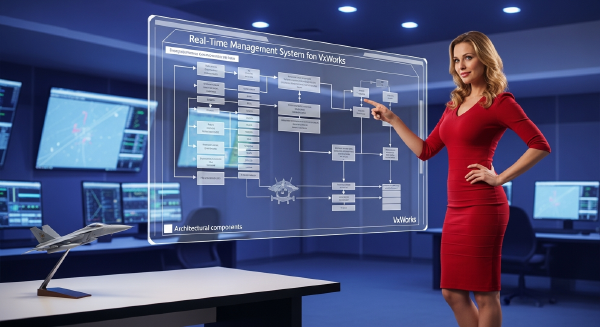
Engineering flight simulators demand strict real-time performance, deterministic execution, and reliable coordination across multiple subsystems. At the core of such systems lies a real-time management system, responsible for orchestrating computation, communication, and control.
This article presents the architecture and implementation of a VxWorks-based real-time management system designed for large-scale flight simulation platforms, with a focus on multitasking, multiprocessor coordination, and distributed data exchange.
🚀 Introduction: Role of the Real-Time Management System #
A flight simulation platform integrates multiple subsystems:
- Simulation computers
- Instructor control station
- Visual rendering system
- Motion platform
- Cockpit instruments and controls
- Audio and environmental modules
The real-time management system acts as the central control layer, ensuring:
- Deterministic task scheduling
- Coordinated subsystem execution
- Real-time data consistency
- Fault detection and recovery
Given the complexity and timing constraints, such systems are typically implemented using distributed multiprocessor architectures, requiring a robust RTOS foundation.
⚙️ Why VxWorks for Flight Simulation #
VxWorks is widely adopted in aerospace systems due to its deterministic behavior and modular design.
Core Characteristics #
-
Deterministic scheduling
Priority-based preemptive scheduler with predictable latency -
Microkernel architecture
Minimal footprint with configurable components -
High reliability
Proven in mission-critical aerospace and defense systems -
Multiprocessor support
Supports SMP and AMP configurations -
Rich IPC mechanisms
Semaphores, message queues, shared memory, and events -
Development toolchain
Integrated debugging and analysis tools (e.g., WindView)
These features make VxWorks suitable for systems requiring strict timing guarantees and high system integrity.
🧱 System Architecture: Distributed Multiprocessor Design #
The flight simulation system is built on a distributed architecture, where computation is partitioned across multiple processors.
Core Components #
-
Simulation CPUs
Execute real-time models such as flight dynamics, engines, and avionics -
Management CPU (VxWorks)
Coordinates scheduling, communication, and system control -
VME Bus Infrastructure
Provides interconnection between processing units
Reflective Memory Network #
To meet real-time communication requirements, the system uses reflective memory:
- Deterministic, low-latency data sharing
- Automatic memory replication across nodes
- Eliminates software overhead for synchronization
This architecture ensures tight coupling between subsystems while maintaining scalability.
🧩 Core Functions of the Management System #
The real-time management layer implements several critical functions:
System Initialization #
- Load simulation models
- Configure runtime parameters
- Activate subsystems in a controlled sequence
Real-Time Scheduling #
- Manage periodic tasks (e.g., 20 ms simulation frames)
- Ensure deadline compliance across all subsystems
Data Management #
- Handle real-time input/output streams
- Record and replay simulation data
- Support offline analysis
Monitoring and Debugging #
- Provide graphical interfaces for operators
- Enable runtime parameter tuning
- Support fault injection and diagnostics
Communication Control #
- Coordinate data exchange across processors
- Integrate shared memory, reflective memory, and network protocols
🔄 Multitasking and Scheduling Strategy #
Efficient multitasking is essential to maintain deterministic behavior in real-time simulation.
Task Management Techniques #
- Use
taskSpawn,taskSuspend, andtaskDeletefor lifecycle control - Assign priorities based on timing criticality
- Configure stack sizes to prevent overflow
Real-Time Considerations #
- Avoid priority inversion using appropriate synchronization
- Minimize blocking operations in critical paths
- Apply CPU affinity in multiprocessor systems
Performance Analysis #
- Use tools such as WindView to analyze:
- Task execution timelines
- Context switching behavior
- CPU utilization
These techniques ensure predictable execution across all simulation tasks.
🔗 Real-Time Data Communication #
Data exchange is a critical factor in distributed simulation systems.
Reflective Memory Mechanism #
- Hardware-level memory synchronization
- Near-zero latency for shared data
- Suitable for tightly coupled simulation loops
Network-Based Communication #
- Ethernet and TCP/IP for non-real-time data
- Used for supervisory control and external interfaces
Optimization Strategies #
- Align data structures for efficient access
- Avoid redundant memory copies
- Synchronize communication cycles with simulation frames
These optimizations reduce jitter and maintain timing consistency.
🖥️ Human-Machine Interface Integration #
The system includes graphical interfaces for monitoring and control:
- Real-time visualization of simulation parameters
- Interactive control panels for instructors
- Debugging tools for engineers
Technologies such as X Window System or Motif are used to implement these interfaces, enabling efficient interaction with the simulation environment.
📌 Conclusion #
The VxWorks-based real-time management system described here demonstrates how deterministic scheduling, multiprocessor coordination, and efficient communication can be combined to support large-scale flight simulation.
By leveraging VxWorks’ strengths—predictability, modularity, and robust IPC—the system achieves:
- Stable multitask execution
- Low-latency distributed communication
- High reliability under strict real-time constraints
This architecture provides a proven blueprint for developing advanced simulation platforms and other mission-critical real-time systems in aerospace and beyond.