Developing AFDX Applications on VxWorks for Avionics Systems
Modern avionics systems demand deterministic, low-latency, and fault-tolerant communication infrastructures capable of supporting increasingly complex airborne subsystems.
VxWorks, developed by Wind River, remains one of the most widely deployed real-time operating systems (RTOS) in aerospace and defense environments due to its:
- Deterministic scheduling
- Efficient interrupt handling
- Stable resource management
- Mature networking stack
- High reliability under real-time workloads
At the same time, Avionics Full-Duplex Switched Ethernet (AFDX), standardized under ARINC 664 Part 7, has become the dominant deterministic Ethernet architecture for modern aircraft communication systems.
Compared with traditional avionics buses such as ARINC 429, AFDX delivers:
- Higher bandwidth
- Deterministic latency
- Redundant communication paths
- Improved scalability
- Better subsystem integration
This article explores the implementation and development of AFDX applications on VxWorks platforms, focusing on:
- PCI device configuration
- AFDX system architecture
- Virtual Link configuration
- Real-time communication mechanisms
- Deterministic avionics networking
✈️ Introduction to AFDX Development on VxWorks #
The system platform discussed in this implementation is based on:
- Freescale PowerPC (PPC) processors
- VxWorks RTOS
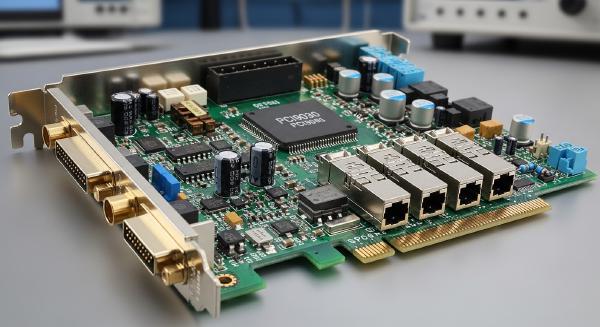
- Commercial off-the-shelf (COTS) AFDX interface boards
The AFDX module communicates with the PowerPC processor through the PCI bus.
This architecture enables:
PPC CPU ↔ PCI Bus ↔ AFDX Interface ModuleBecause VxWorks provides mature PCI subsystem support, developers can efficiently integrate AFDX hardware into real-time avionics applications.
However, successful deployment depends heavily on:
- Correct PCI configuration
- BSP integration
- Memory mapping
- Deterministic networking setup
- Virtual Link planning
⚙️ PCI Configuration in VxWorks #
PCI configuration forms the foundation of AFDX hardware integration.
VxWorks includes extensive support for:
- PCI device discovery
- Configuration-space access
- BAR mapping
- Interrupt handling
- MMU-assisted address translation
Proper PCI initialization ensures that the AFDX hardware can communicate reliably with the processor and networking stack.
🧩 PCI Device Addressing #
Every PCI device is uniquely identified using three parameters:
| Parameter | Description |
|---|---|
| Bus Number | Identifies the PCI bus hierarchy |
| Device Number | Identifies the device on the bus |
| Function Number | Identifies functions within multi-function devices |
Together, the tuple:
(Bus, Device, Function)uniquely identifies a PCI device.
Bus Number #
Bus numbering begins at:
0and expands hierarchically through PCI bridges.
Device Number #
Each bus can contain multiple devices assigned unique device IDs.
Function Number #
Multi-function devices support up to:
8 functions (0–7)although many devices only expose Function 0.
🧠 PCI Configuration Space #
Every PCI device exposes a standardized:
256-byte PCI Configuration SpaceThis region contains critical hardware metadata and resource mappings.
Important PCI Registers #
| Register | Purpose |
|---|---|
| Vendor ID | Manufacturer identifier |
| Device ID | Device identifier |
| Revision ID | Hardware revision |
| Class Code | Functional classification |
| BARs | Memory or I/O mapping definitions |
The Base Address Registers (BARs) are especially important because they determine:
- Device memory regions
- I/O address ranges
- DMA-accessible buffers
These mappings must align correctly with BSP memory layouts.
🔧 VxWorks PCI Support Functions #
VxWorks provides a rich PCI API for device management.
Common PCI Functions #
| Function | Description |
|---|---|
pciFindDevice |
Locate device by Vendor ID and Device ID |
pciFindClass |
Locate device by Class Code |
pciConfigBdfPack |
Pack Bus/Device/Function tuple |
pciConfigInLong |
Read 32-bit configuration value |
pciConfigOutLong |
Write 32-bit configuration value |
These APIs allow developers to:
- Enumerate PCI devices
- Configure hardware resources
- Access device registers
- Initialize AFDX hardware drivers
MMU and BSP Considerations #
During system boot, VxWorks performs PCI address-space mapping.
With full MMU support enabled:
Address translation and memory mapping
are handled automatically.
Without MMU support, developers may need to manually modify:
- BSP configuration
- Memory mapping tables
- PCI initialization routines
This is especially important in deterministic avionics systems where incorrect mappings can lead to unstable behavior.
🌐 AFDX System Architecture #
AFDX introduces deterministic Ethernet communication into avionics systems while preserving compatibility with standard IEEE 802.3 Ethernet physical layers.
An AFDX system typically consists of three primary components.
🛰️ Avionics Subsystems #
These include traditional aircraft systems such as:
- Flight control computers
- GPS/navigation modules
- Health monitoring systems
- Cockpit displays
- Sensor fusion systems
Each subsystem generates or consumes deterministic communication traffic.
🔌 AFDX End Systems #
AFDX End Systems serve as secure gateways between avionics subsystems and the AFDX network.
Their responsibilities include:
- Frame encapsulation
- Traffic shaping
- Virtual Link management
- Bandwidth enforcement
- Redundancy handling
Each End System ensures that subsystem traffic complies with ARINC 664 deterministic constraints.
🔀 AFDX Switches #
AFDX switches are full-duplex Ethernet switches optimized for deterministic forwarding.
Unlike traditional Ethernet switches, AFDX switches enforce:
- Bounded latency
- Controlled jitter
- Virtual Link isolation
- Predictable queue behavior
This architecture eliminates collision domains and significantly improves reliability.
🛣️ Virtual Links in AFDX #
The core communication abstraction in AFDX is the:
Virtual Link (VL)A Virtual Link defines a:
Unidirectional logical communication channel
from one source End System
to one or more destination End Systems.
Although multiple VLs share the same physical Ethernet infrastructure, each VL behaves as an isolated deterministic communication path.
📦 Key AFDX Network Configuration Parameters #
Each Virtual Link requires strict configuration.
Core Configuration Elements #
| Parameter | Description |
|---|---|
| Virtual Link ID | Logical channel identifier |
| BAG | Bandwidth Allocation Gap |
| Source IP | Sender IP address |
| Destination IP | Receiver IP address |
| UDP Ports | Application-level routing |
| MAC Addresses | Ethernet-level routing |
| Port Type | Sampling or queuing behavior |
These parameters collectively define:
- Transmission frequency
- Bandwidth allocation
- Routing behavior
- Deterministic timing guarantees
📊 Example AFDX Message Mapping #
An example End System configuration may look like:
| Message ID | AFDX Port | Source UDP | Source IP | Source MAC | Destination MAC (VL) | Destination IP | Destination UDP |
|---|---|---|---|---|---|---|---|
| 1 | 1 | UDP1 | IP5 | MAC5 | VL1 | IP1 | UDP1 |
| 2 | 2 | UDP2 | IP5 | MAC5 | VL1 | IP1 | UDP2 |
Multiple messages can share the same Virtual Link while still maintaining:
- Bandwidth guarantees
- Timing constraints
- Deterministic delivery
Equivalent routing tables are configured for additional End Systems such as:
- ESA
- ESB
- ESC
ensuring proper traffic isolation and deterministic communication.
⏱️ Real-Time Determinism in AFDX #
AFDX achieves deterministic behavior through several mechanisms:
- Full-duplex Ethernet
- Virtual Link isolation
- BAG timing enforcement
- Traffic shaping
- Bounded switch latency
Bandwidth Allocation Gap (BAG) #
BAG defines:
The minimum interval between
two consecutive frames on a VL.
This guarantees controlled transmission rates and prevents uncontrolled bursts.
Traffic Shaping #
End Systems use traffic-shaping algorithms to smooth frame transmission and prevent congestion.
This ensures:
- Predictable latency
- Bounded jitter
- Stable queue behavior
These mechanisms are critical for safety-certified avionics systems.
🧵 VxWorks and Real-Time AFDX Integration #
VxWorks is particularly well-suited for AFDX development because of its deterministic kernel behavior.
Key Advantages #
| Feature | Benefit |
|---|---|
| Deterministic scheduling | Predictable task execution |
| Fast interrupt handling | Low-latency frame processing |
| Efficient IPC | Reliable subsystem coordination |
| Mature driver model | Stable hardware integration |
| PCI support | Simplified AFDX device management |
This combination enables reliable implementation of:
- Real-time data transmission
- Status monitoring
- Deterministic control loops
- Flight-critical messaging
🔒 Reliability and Stability Considerations #
Safety-critical avionics systems impose extremely strict reliability requirements.
Developers must carefully validate:
- PCI mappings
- Interrupt behavior
- VL scheduling
- Queue depth
- Redundancy switching
- Worst-case latency
Improper configuration may result in:
- Excessive jitter
- Packet delays
- Queue congestion
- Deterministic violations
Therefore, extensive offline timing analysis and runtime monitoring are mandatory.
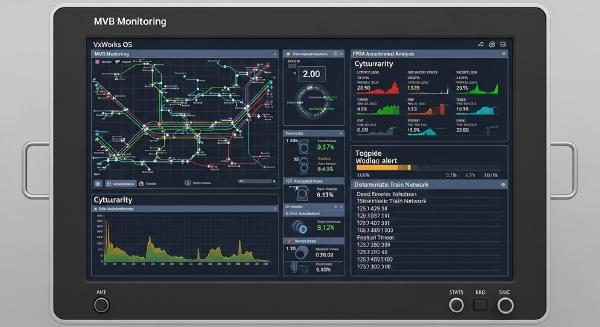
Upper-layer monitoring systems are commonly used to observe:
- Communication health
- Network performance
- Latency stability
- Fault conditions
🚀 Final Thoughts #
AFDX represents one of the most important advances in deterministic avionics networking, enabling Ethernet to satisfy the strict timing and reliability demands of modern airborne systems.
Combined with the real-time capabilities of VxWorks, developers can build highly stable and deterministic communication platforms suitable for:
- Flight control systems
- Navigation systems
- Aerospace monitoring platforms
- Mission-critical embedded infrastructure
Successful implementation depends on:
- Correct PCI configuration
- Proper BSP integration
- Accurate Virtual Link planning
- Deterministic traffic engineering
By leveraging VxWorks’ mature PCI subsystem and ARINC 664-compliant AFDX architectures, engineers can construct scalable, certifiable, and highly reliable avionics communication systems capable of meeting the stringent requirements of modern aerospace environments.