
MUAV Airborne Computer Design with RTLinux and Sensor Fusion
Micro Unmanned Aerial Vehicles (MUAVs) require compact, efficient, and highly deterministic onboard computing systems to support autonomous flight. These systems must process multi-sensor data, execute control algorithms, and maintain stable communication with ground stations under strict real-time constraints.
This article presents a design approach for an RTLinux-based airborne computer system, focusing on hardware architecture, multi-sensor data fusion, and flight attitude computation.
✈️ System Overview and Design Requirements #
The airborne computer system is the core of MUAV control, responsible for:
- Acquiring sensor data (attitude, position, altitude)
- Performing real-time data fusion and filtering
- Executing flight control algorithms
- Managing communication with ground control
Key Requirements #
- Deterministic real-time execution
- Low latency for control loops
- High reliability and fault tolerance
- Efficient multi-task scheduling
RTLinux is selected due to its ability to provide hard real-time capabilities while retaining Linux flexibility for non-critical tasks.
🧩 Hardware Architecture #
System Components #
The MUAV airborne system integrates multiple subsystems:
-
Sensors:
- Tri-axis accelerometer
- Gyroscope
- Magnetometer
- Sonar altimeter
- GPS receiver
-
Processing Unit:
- RTLinux-based controller (PC/104 platform)
-
Actuators:
- Servo motors for:
- Collective pitch
- Cyclic control
- Tail rotor
- Throttle
- Servo motors for:
-
Communication Module:
- Wireless link (IEEE 802.11b, 2.4 GHz)
-
Power and Switching:
- Multi-channel switching for redundancy between onboard and ground control
🖥️ Embedded Platform Selection #
The system uses a PC/104-based embedded CPU module to balance performance, size, and power consumption.
Key Characteristics #
- 800 MHz processor
- Low power design suitable for airborne systems
- Built-in watchdog timer
- Rich I/O interfaces:
- Serial (RS-232/485)
- USB 2.0
- Ethernet
- Support for PC/104 and PC/104-Plus expansion
This configuration provides sufficient computational power and connectivity for real-time sensor processing and control.
📡 Multi-Sensor Information Fusion #
Accurate flight control depends on combining data from heterogeneous sensors. Multi-sensor fusion improves robustness, accuracy, and reliability.
JDL Data Fusion Model #
The fusion process is structured using the JDL model:
- Level 0: Signal preprocessing
- Level 1: State estimation (object refinement)
- Level 2: Situation assessment
- Level 3: Threat/impact analysis
- Level 4: Process optimization
Fusion Levels #
-
Data Layer Fusion
- Highest accuracy
- High computational cost
-
Feature Layer Fusion
- Balanced performance and efficiency
-
Decision Layer Fusion
- Fast but less precise
Common Algorithms #
- Bayesian estimation
- Dempster–Shafer evidence theory
- Fuzzy logic
- Neural networks
Algorithm selection must balance computational complexity with real-time constraints.
🧮 Flight Attitude Calculation #
Attitude estimation converts sensor measurements into orientation angles relative to the earth frame.
Coordinate Transformation #
The transformation between body and earth coordinate systems is defined by a direction cosine matrix:
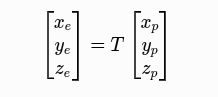
Where:
- $$ ( x_p, y_p, z_p ) $$ : body-frame coordinates
- $$ ( x_e, y_e, z_e ) $$ : earth-frame coordinates
- $$ ( T ) $$ : transformation matrix derived from Euler angles
Euler Angle Extraction #
- Pitch: $$ ( \theta = \sin^{-1}(t_{23}) ) $$
- Yaw: $$ ( \varphi = \cos^{-1}(t_{22} / \cos\theta) ) $$
- Roll: $$ ( \gamma = \cos^{-1}(t_{33} / \cos\theta) ) $$
Solution Methods #
- Euler angle method (simple but prone to singularities)
- Quaternion method (robust and widely used)
- Direction cosine matrix method (stable but computationally heavier)
⏱️ Real-Time Execution with RTLinux #
RTLinux ensures deterministic execution for critical flight tasks:
- Real-time scheduling for control loops
- Low interrupt latency for sensor data acquisition
- Separation of real-time and non-real-time processes
This architecture allows:
- Precise timing for control algorithms
- Reliable handling of sensor updates
- Stable communication with ground systems
🔧 System Integration Considerations #
Key design trade-offs include:
-
Accuracy vs. Latency
Higher precision fusion increases computational load -
Sensor Redundancy vs. Power Consumption
More sensors improve reliability but increase energy usage -
Algorithm Complexity vs. Real-Time Constraints
Lightweight algorithms are preferred for tight control loops
🧾 Conclusion #
The RTLinux-based airborne computer system provides a practical and efficient solution for MUAV control. By integrating a PC/104 embedded platform with multi-sensor fusion and real-time attitude computation, the system achieves:
- Deterministic real-time performance
- Accurate and robust attitude estimation
- Scalable and modular system architecture
This design serves as a solid foundation for developing reliable and autonomous micro UAV systems across a range of applications.