QNX Development Environment: Building Safety-Critical Embedded Systems for the Software-Defined Era
Modern embedded systems increasingly blur the boundary between traditional software engineering and real-time systems design. Nowhere is this transformation more visible than in automotive platforms, where vehicles have evolved into distributed computing systems running millions of lines of code across dozens of processors and Electronic Control Units (ECUs).
At the center of many of these systems is the QNX real-time operating system (RTOS), a platform widely adopted in automotive, industrial, aerospace, railway, and medical applications that demand deterministic behavior, fault isolation, and functional safety certification.
Unlike general-purpose operating systems designed primarily for throughput and desktop-style applications, QNX is engineered around predictability, resilience, and long-term reliability. For engineers building safety-critical systems, understanding the QNX development environment is increasingly becoming a core embedded software skill.
🚗 What Makes QNX Different? #
QNX is built around a microkernel architecture, a design philosophy fundamentally different from traditional monolithic kernels such as Linux.
In a monolithic operating system, major subsystems execute inside kernel space:
- Device drivers
- File systems
- Networking stacks
- IPC layers
- Multimedia frameworks
A failure in one subsystem can potentially compromise the entire system.
QNX minimizes this risk by intentionally keeping the kernel extremely small. The QNX Neutrino microkernel is responsible only for a few critical low-level functions:
- Thread scheduling
- Inter-process communication (IPC)
- Interrupt handling
- Synchronization primitives
- Memory protection services
Everything else runs as isolated user-space services:
- Device drivers
- Networking services
- File systems
- Audio stacks
- GUI frameworks
- Middleware
This architecture provides one of QNX’s defining advantages:
A failed driver or subsystem can often be restarted independently without rebooting the entire operating system.
For automotive, aerospace, industrial automation, and medical systems requiring continuous uptime, this isolation model is enormously valuable.
Microkernel vs Monolithic Architecture #
| Feature | QNX Microkernel | Traditional Linux Kernel |
|---|---|---|
| Kernel Size | Extremely small | Large monolithic kernel |
| Driver Isolation | User-space | Kernel-space |
| Fault Containment | Strong | Limited |
| System Recovery | Service restart possible | Often requires reboot |
| Determinism | High | Moderate |
| Safety Certification | Strong support | More difficult |
| Real-Time Predictability | Excellent | Depends on PREEMPT_RT |
⏱️ Deterministic Real-Time Performance #
The defining requirement of a real-time operating system is not raw performance — it is deterministic timing behavior.
A multimedia application can tolerate occasional latency spikes.
A brake controller cannot.
QNX provides several capabilities specifically designed for deterministic execution:
- Fully preemptive priority scheduling
- Deterministic interrupt response
- Priority inheritance
- Bounded latency
- Symmetric multiprocessing (SMP)
- CPU affinity control
- Fine-grained thread priorities
These features allow engineers to design systems where critical tasks consistently execute within strict timing windows.
Typical Real-Time Applications #
| Industry | Example Systems |
|---|---|
| Automotive | ADAS, digital clusters, drive-by-wire |
| Industrial | Robotics, PLCs, CNC controllers |
| Aerospace | Flight control, mission systems |
| Railway | Train control systems |
| Medical | Ventilators, patient monitoring |
| Telecommunications | Base stations, packet processing |
In these environments, predictability matters far more than average throughput.
🧩 POSIX Compatibility and Software Portability #
One reason QNX remains attractive to engineering teams is its strong POSIX compliance.
QNX Neutrino supports much of the standard POSIX API ecosystem:
- POSIX threads (
pthread) - Signals
- Timers
- Shared memory
- Message queues
- Sockets
- File I/O
- Semaphores
This dramatically lowers the barrier for porting UNIX or Linux applications into real-time environments.
Developers can often reuse:
- Existing middleware
- Networking libraries
- Open-source frameworks
- IPC infrastructure
- Application logic
while modifying only the timing-sensitive or hardware-dependent portions of the software.
This portability is especially important in modern software-defined vehicle (SDV) architectures where Linux, Android, and RTOS environments frequently coexist.
🛠️ The QNX Development Environment #
QNX development typically revolves around several major components.
QNX SDP (Software Development Platform) #
The QNX Software Development Platform (SDP) provides the complete embedded development toolchain:
- Cross-compilers
- Runtime libraries
- Linkers
- Build tools
- Deployment utilities
- Debugging infrastructure
- Performance analysis tools
Development is usually performed on Linux host systems while targeting ARM or x86 embedded hardware.
Typical QNX Cross-Compilation Workflow #
qcc -Vgcc_ntoaarch64le -o app main.cThe qcc compiler wrapper automatically selects the appropriate toolchain and runtime libraries.
🖥️ QNX Momentics IDE #
QNX Momentics is the Eclipse-based Integrated Development Environment (IDE) used for:
- Project management
- Cross-compilation
- Remote deployment
- System profiling
- Debugging
- Kernel tracing
Momentics integrates tightly with QNX runtime instrumentation.
Major Debugging Features #
| Capability | Purpose |
|---|---|
| Kernel Event Tracing | Analyze scheduling and interrupts |
| Thread Analysis | Inspect thread states and priorities |
| Latency Measurement | Measure deterministic behavior |
| Memory Profiling | Detect leaks and fragmentation |
| Remote GDB Debugging | Debug target hardware remotely |
Timing-sensitive embedded bugs are often difficult to reproduce, making these tracing tools essential.
🧱 BSPs (Board Support Packages) #
Board Support Packages are foundational to every QNX deployment.
A BSP typically contains:
- Bootloader integration
- Startup code
- MMU configuration
- Interrupt controller setup
- Peripheral initialization
- Clock configuration
- Device drivers
Porting QNX to new hardware platforms often requires extensive BSP engineering work.
Common Automotive SoCs Supported #
| Vendor | Platform |
|---|---|
| Qualcomm | Snapdragon Automotive |
| Renesas | R-Car |
| NXP | i.MX |
| TI | Jacinto |
| NVIDIA | DRIVE |
BSP quality directly impacts:
- System stability
- Boot reliability
- Interrupt latency
- Driver behavior
- Overall determinism
🚘 QNX in Automotive Systems #
The automotive industry has become QNX’s largest and most visible deployment sector.
QNX powers systems such as:
- Digital cockpits
- Instrument clusters
- Infotainment systems
- Telematics units
- ADAS controllers
- Autonomous driving compute systems
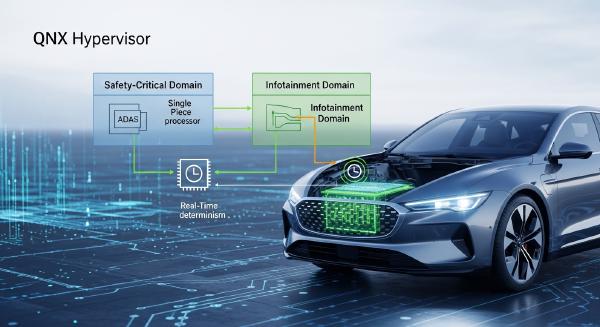
One major reason is QNX’s support for mixed-criticality workloads.
A single automotive SoC may simultaneously run:
- Safety-certified instrument clusters
- Android infotainment
- Navigation software
- Connectivity stacks
- Vehicle diagnostics
while maintaining strict isolation between domains.
This architecture is central to modern software-defined vehicle platforms.
🧬 QNX Hypervisor and System Consolidation #
Modern vehicle architectures increasingly consolidate multiple ECUs onto centralized compute platforms.
QNX Hypervisor enables this consolidation through virtualization.
A single processor can host:
- QNX guests
- Linux guests
- Android guests
with strict partitioning between operating systems.
Example Consolidated Architecture #
| Domain | Operating System |
|---|---|
| Instrument Cluster | QNX |
| Infotainment | Android |
| Connectivity | Linux |
| Safety Controller | QNX |
all executing simultaneously on the same hardware.
Advantages of Consolidation #
- Reduced hardware costs
- Simplified wiring
- Lower power consumption
- Easier OTA management
- Centralized compute resources
This architecture is increasingly common in next-generation automotive platforms.
🔒 Functional Safety and Certification #
One of QNX’s strongest industry advantages is its certification ecosystem.
QNX supports standards including:
| Standard | Industry |
|---|---|
| ISO 26262 | Automotive |
| IEC 61508 | Industrial |
| IEC 62304 | Medical |
| DO-178C | Aerospace |
QNX OS for Safety supports certification levels up to:
- ASIL D
- SIL 3
This substantially reduces the certification burden for OEMs and Tier-1 suppliers.
However, certification is never automatic.
Engineering teams must still perform:
- Hazard analysis
- Timing validation
- Fault injection testing
- Safety case development
- Requirements traceability
- Verification and validation
The RTOS provides the foundation, but complete certification remains a system-level responsibility.
📨 IPC and the QNX Messaging Model #
One of QNX’s most elegant architectural concepts is its message-passing IPC system.
Rather than relying heavily on shared memory synchronization, QNX encourages communication through synchronous messaging primitives.
Core IPC APIs #
MsgSend()
MsgReceive()
MsgReply()
This creates a clean client-server abstraction between processes.
Advantages of Message Passing #
- Strong fault isolation
- Reduced race conditions
- Predictable synchronization
- Cleaner modular design
- Easier fault recovery
This messaging architecture aligns naturally with distributed embedded systems.
⚠️ Common Engineering Challenges #
Despite its strengths, QNX development presents several practical challenges.
Specialized Tooling #
Engineers transitioning from Linux often face a learning curve involving:
- Momentics workflows
- Resource managers
- QNX startup scripts
- System tracing tools
- BSP architecture
Limited Driver Ecosystem #
Compared to Linux, QNX has a smaller open-source driver ecosystem.
Teams often need to:
- Port Linux drivers
- Write custom BSP code
- Adapt vendor SDKs
- Integrate proprietary middleware
This requires deep hardware expertise.
Real-Time Debugging Complexity #
Deterministic bugs are notoriously difficult to reproduce.
Examples include:
- Race conditions
- Interrupt storms
- Scheduler starvation
- Priority inversion
- Timing jitter
QNX tracing tools significantly help, but diagnosing real-time failures remains a specialized engineering discipline.
Mixed-OS Integration Challenges #
Combining QNX with Android or Linux introduces additional complexity:
- Shared memory coordination
- Hypervisor partitioning
- GPU virtualization
- Secure inter-domain communication
- Multimedia routing
As centralized compute architectures evolve, these challenges continue growing.
🧠 Best Practices for QNX Engineering Teams #
Successful QNX projects typically adopt several core practices early in development.
Define Timing Requirements Early #
Real-time scheduling must be intentionally designed.
Tasks should be classified as:
- Hard real-time
- Soft real-time
- Background/non-critical
Poor priority assignment can destabilize the entire platform.
Stabilize the BSP First #
Hardware instability propagates upward into every software layer.
Early BSP validation helps eliminate:
- Phantom software bugs
- Timing anomalies
- Interrupt routing problems
- Driver race conditions
Use Resource Managers Consistently #
QNX resource managers provide standardized device abstractions.
Well-designed resource managers improve:
- Portability
- Maintainability
- Fault isolation
- Testability
Design for Recovery #
QNX’s service isolation should be fully leveraged.
Subsystems should support:
- Graceful restart
- Watchdog supervision
- Fault containment
- Independent recovery
rather than assuming full-system reboots.
🚀 QNX in the Software-Defined Vehicle Era #
The automotive industry is rapidly transitioning toward software-defined vehicle (SDV) architectures.
This shift increases demand for platforms capable of:
- Mixed-criticality execution
- Functional safety
- Secure OTA updates
- Deterministic scheduling
- Hypervisor-based isolation
- Long lifecycle support
QNX is particularly well-positioned for this transformation because its architectural strengths align directly with these requirements.
Rather than replacing Linux or Android, QNX increasingly serves as the deterministic, safety-certified foundation beneath higher-level ecosystems.
📌 Final Thoughts #
QNX development differs fundamentally from traditional application programming.
Engineers must simultaneously consider:
- Timing guarantees
- Fault isolation
- Hardware interaction
- Functional safety
- Deterministic scheduling
- Long-term reliability
- System recovery
As vehicles, robots, industrial systems, and edge platforms continue evolving into software-defined machines, deterministic embedded operating systems will only become more important.
For teams building safety-critical embedded systems, expertise in the QNX development environment remains one of the most valuable skills in modern embedded software engineering.