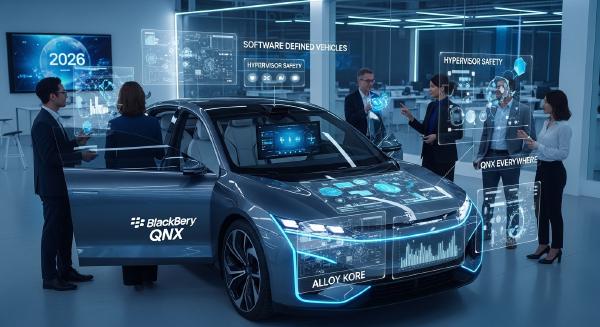
5G V2X Edge Computing: Aptiv, Wind River, Verizon at MWC 2026
The V2X proof-of-concept demonstrated at MWC 2026 marks a transition from experimental deployments to scalable, carrier-grade automotive networking. By combining 5G edge computing (MEC) with software-defined vehicle (SDV) architectures, the solution enables real-time data sharing between vehicles, extending perception beyond physical sensor limits.
This approach transforms V2X from a hardware-constrained system into a software-defined, network-orchestrated platform.
🔍 Integrated V2X Technology Stack #
The demonstration integrates sensing, middleware, and network infrastructure into a unified architecture.
Role Distribution #
-
Aptiv
Provides ADAS sensors, perception algorithms, and the LINC software platform. Responsible for local sensing and sensor fusion. -
Wind River
Delivers the V2X software stack and edge-to-cloud orchestration. Ensures deterministic execution and synchronization between vehicle and edge workloads. -
Verizon Business
Operates the Edge Transportation Exchange (ETX) on top of its 5G and MEC infrastructure. Acts as the low-latency data exchange layer between vehicles.
This separation enables modular evolution while maintaining system-level coordination.
🚗 Collaborative Perception Beyond Line-of-Sight #
The core capability demonstrated is collaborative perception, where vehicles extend their sensing range through shared data.
Data Flow Model #
- A detecting vehicle captures radar and camera data
- Data is transmitted to the MEC platform
- The platform processes and redistributes relevant information
- A receiving vehicle integrates this data as a virtual sensor input
System Behavior #
- External sensor data is treated as native input by the ADAS stack
- Hazards outside line-of-sight can trigger safety functions such as automatic emergency braking
- Processing occurs within milliseconds, maintaining real-time constraints
This effectively creates a distributed sensing network across vehicles.
⚙️ Interoperability Through Network Abstraction #
Traditional V2X implementations rely on direct communication protocols and tightly coupled hardware ecosystems. The MEC-based approach introduces a service-layer abstraction.
Key Improvements #
-
API-Based Communication
Vehicles interact with edge services using standardized interfaces rather than direct peer-to-peer protocols. -
Hardware Reuse
Existing 5G modems and ADAS systems eliminate the need for dedicated V2X modules. -
Vendor Neutrality
Data exchange occurs through the network, enabling interoperability across different OEM platforms.
This model removes a major barrier to large-scale V2X deployment.
📊 Architecture Comparison #
| Feature | Traditional V2X | MEC-Based V2X |
|---|---|---|
| Connectivity | DSRC or direct C-V2X | 5G cellular with MEC |
| Latency | Low but range-limited | Ultra-low with edge processing |
| Hardware | Dedicated V2X modules | Standard 5G and ADAS hardware |
| Scalability | Hardware-dependent | Software-driven deployment |
The shift from device-centric to network-centric communication is the defining change.
🚀 Implications for Software-Defined Vehicles #
The demonstrated architecture aligns with SDV principles by decoupling functionality from hardware constraints.
System-Level Benefits #
- Real-time coordination across vehicles and infrastructure
- Dynamic feature deployment via software updates
- Centralized optimization at the network edge
Expanded Use Cases #
- Traffic flow optimization through coordinated vehicle behavior
- Enhanced safety for autonomous systems in complex environments
- Real-time environmental awareness integrated into cockpit systems
These capabilities extend V2X beyond safety into system-wide intelligence.
📌 Conclusion #
The MWC 2026 V2X demonstration shows that 5G MEC can deliver scalable, low-latency vehicle communication without requiring specialized hardware. By moving coordination to the network edge and leveraging SDV architectures, the solution enables collaborative perception and cross-vendor interoperability.
This approach represents a practical path toward large-scale deployment of connected vehicle systems, where software-defined capabilities and edge infrastructure define the next phase of automotive innovation.